What height setting of the first hill will cause the 35 g car to reach the egg in 1.88 s?
One-Dimensional Kinematics Review
Navigate to:
Review Session Dwelling house - Topic List
1D Kinematics - Habitation || Printable Version || Questions and Links
Answers to Questions: #1-seven || #eight-#28 || #29-#42 || #43-#50
Function E: Computational Bug
43. Determine the acceleration (in one thousand/south2) of an object which ... .
- moves in a straight line with a constant speed of twenty.0 m/s for 12.0 seconds
- changes its velocity from 12.1 one thousand/s to 23.5 m/s in 7.81 seconds
- changes its velocity from 0.0 mi/60 minutes to threescore.0 mi/hr in 4.twenty seconds
- accelerates from 33.4 grand/south to 18.9 thou/s over a distance of 109 yard
Reply: Run across answers, explanations and calculations below.
a. If the speed and management of an object is constant, then the acceleration is 0 yard/s2 .
b. The dispatch is the velocity change per time ratio:
c. The acceleration is the velocity change per time ratio:
14.3 mi/hr/s * (1.0 m/due south) / (two.24 mi/hr) = half dozen.38 m/sii .
d. The acceleration value can also be calculated using kinematic equations if iii other kinematic quantities are known. In this case, the know information is: vo = 33.four chiliad/s; vf = eighteen.9 m/south; and d = 109 yard. Using the equation vf 2 = vo 2 + 2*a*d, the acceleration can be computed.
44. Decide the magnitude of the displacement (in meters) of an object which ... .
- moves from Hither to Yon (with an average speed of 28.0 grand/s) and then back to Hither (with an average speed of 28.0 yard/s) if both the frontwards and the render trip take 46 minutes each.
- moves at a abiding speed of 8.30 g/s in a straight line for fifteen.0 seconds.
- decelerates at a rate of -4.35 m/s/s from a speed of 38.ane m/due south to a speed of 17.6 m/s
- accelerates from residual at a rate of 3.67 1000/sii for 12.ane seconds
- is moving at 12.ii thou/s and then accelerates at a charge per unit of +1.88 m/s2 for 17.0 seconds
Answer: Meet answers, explanations and calculations below.
a. Since this is a round-trip journey, the overall displacement is 0 thousand.
b. Since the velocity is constant, the displacement can exist found by multiplying the velocity by the fourth dimension.
c. A displacement value can besides be calculated using kinematic equations if three other kinematic quantities are known. In this case, the know information is: vo = 38.ane m/south; vf = 17.half-dozen m/s; and a = -4.35 1000/s/s. Using the equation vf 2 = vo 2 + two*a*d, the displacement can be computed.
d. A deportation value tin exist calculated using other kinematic equations if a different set of kinematic quantities is known. Here we know that: fiveo = 0.0 m/s; t = 12.one s; and a = 3.67 m/due south/s. Using the equation d = vo* t + 0.5*a*tii, the displacement can be computed.
e. Hither the deportation value is calculated using the aforementioned kinematic equation. Nosotros know that: 5o = 12.2 m/south; t = 17.0 s; and a = 1.88 1000/s/south. Using the equation d = 5o* t + 0.5*a*t2, the deportation can be computed.
45. The hare is sleeping at a location that is 1200 grand from the stop line. The tortoise passes him at a steady speed of five.0 cm/s. If the hare finally wakes up 6.5 hours later, then what minimum acceleration (assumed constant) must he have in guild to pass the tortoise before the finish line.
Reply: 0.0067 yard/south2
Similar a lot of physics word problems, in that location is more than 1 path to the last reply. In all such problems, the solution involves thought and good problem-solving strategies (draw a film, list what you know, list pertinent equations, etc.).
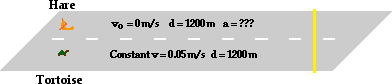
The tortoise, moving at a constant speed, will cover the 1200 1000 in a time of:
The hare will sleep for 6.5 hrs (23400 s) before starting, and so volition accept simply 0.1666... hrs (600 s) to accelerate to the cease line. So the dispatch of the hare tin can exist make up one's mind using a kinematic equation. The know information most the hare's motion is: t = 600 due south; d = 1200 one thousand; vo = 0 m/s. The best equation is d = fiveo* t + 0.five*a*t2. The vo* t term cancels and the equation can be algebraically rearranged and solved for a:
46. A Gold Automobile moving at 12.0 m/s passes a Dark-green Motorcar while the Green Car is at rest at a stoplight. The Green Car immediately accelerates at a rate of +1.80 m/s/due south for xi.0 seconds seconds and and so maintains a constant speed. Later how much time (relative to the initial starting fourth dimension) must the Green Car drive earlier communicable up with the Golden Car .
Answer: 14.0 s
(Every bit mentioned in the previous trouble ...) Like a lot of physics word problems, there is more than one path to the last answer. In all such problems, the solution involves thought and good problem-solving strategies (draw a picture, list what you know, list pertinent equations, etc.).

Here the golden car travels with a constant speed for a time of t seconds (where t is the full fourth dimension of travel for both cars). The distance traveled by the gold auto is given by the kinematic equation d = vo* t + 0.5*a*ttwo. The second term cancels and the distance tin be expressed equally
dgolden = 12.0* t
For the light-green car, there is an accelerated period and then a constant speed catamenia. The distance traveled during the accelerated period (d1green) is found from the same kinematic equation. For the green motorcar, the first term cancels and the distance is
d1green = 108.9 m
In one case the green car has accelerated for 11 seconds, it maintains a constant speed for the remaining time, given by the expression t - xi southward. The speed at which the light-green motorcar is traveling during this time can be computed using the equation:
The distance traveled by the green machine during this constant speed portion of its movement (d2green) tin be computed using the kinematic equation. d = fiveo* t + 0.v*a*ttwo. The second term cancels and the distance can exist expressed as
d2green = nineteen.eight*t - 217.8
So the total distance traveled past the dark-green car is given by the expression:
dgreen = 19.8*t - 108.9
When the dark-green car catches up to the gold auto their distance traveled will exist the same. So the time t can be determined by setting the 2 expressions for distance equal to each other and solving for t.
108.ix = 7.80*t
t = (108.9) / (7.eighty)
t = xiii.96 south = 14.0 s
47. Ima Rilla Saari is cruising at 28.0 m/s down Lake Avenue and through the forest preserve. She notices a deer jump into the road at a location 62.0 yard in front of her. Ima first reacts to the event, then slams on her brakes and decelerates at -eight.x m/due south2, and ultimately stops a picometer in front of the frozen deer. What is Ima's
reaction time ? (i.due east., how long did it take Ima to react to the event prior to decelerating?)
Answer: 0.486 s
Ima's total distance traveled (62.0 m) can exist broken into two segments - a reaction distance (drxn) and a braking distance (dbraking). The reaction distance is the distance Ima moves prior to braking; she will move at abiding speed during this time of trxn . The braking distance is the distance which Ima moves when her foot is on the brake and she decelerates from 28.0 m/s to 0.0 grand/s. The braking distance can be computed starting time using the post-obit kinematic equation: 5f 2 = fiveo two + 2*a*d. The known information for this braking period is: vo = 28 m/due south; fivef = 0 m/s; and a = -8.x k/s/s. The substitutions and solution are shown below.
Since Ima's car requires 48.40 thousand to brake, she can travel a maximum of 13.6 k during the reaction flow. The human relationship between reaction time, speed and reaction distance is given past the equation
Substituting 13.six m for drxn and 28.0 m/s for v, the reaction time tin be computed:
48. A two-stage rocket accelerates from rest at +iii.57 m/s/s for 6.82 seconds. It and then accelerates at +2.98 thou/s/southward for some other 5.ninety seconds. After the second stage, it enters into a state of free autumn. Determine:
- the maximum speed
- the maximum distance
- the height of the rocket afterwards 20.0 seconds
- the total time the rocket is in the air (bold it is launched from the basis)
Respond: See answers and explanations below.
This trouble can be approached by either the utilize of a velocity-time graph or the use of kinematic equations (or a combination of each). Whatever the approach, information technology is imperative to break the multistage motion upwards into its three different acceleration periods. The utilize of kinematic equations is merely appropriate for abiding acceleration periods. For this reason, the complex motion must be broken up into time periods during which the acceleration is abiding. These 3 time periods can be seen on the velocity-time graph by iii lines of distinctly different slope. The diagram at the right provides a depiction of the motion; strategic points are labeled. These points will be referred to in the solutions beneath. The velocity-time plot beneath will be used throughout the solution; annotation that the same strategic points are labeled on the plot.
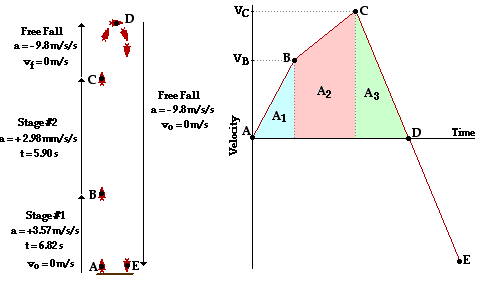
a. The maximum speed occurs after the 2d stage or acceleration catamenia (point C). After this time, the up-moving rocket begins to tiresome down equally gravity becomes the sole force interim upon information technology. To determine this speed (vc), the kinematic equation vf = vo + a*t will be used twice - once for each dispatch period.
2nd Stage: vC = vB + a*t = 24.three m/s + (2.98 m/s/due south) * (5.90 due south) = 41.9 m/s
b. The maximum altitude occurs at indicate D, sometime later on the 2nd stage has ceased and the rocket finally runs out of steam. The velocity at this point is 0 m/southward (it is at the peak of its trajectory). The altitude at this point is the cumulative distance traveled from t = 0 s to t = tD. This altitude is the distance for the first phase, the 2nd phase and the deceleration menstruation (C to D). These distances correspond to the area on the v-t graph; they are labeled A1, Atwo, and Athree on the graph. They are calculated and summed below.
A2 = b*h + 0.5*b*h (a triangle on top of a square)
A2 = (24.3 g/s) * (5.9 south) + 0.5 * (41.ix m/due south - 24.3 thousand/s) * (5.9 s) = 195.42 m
Information technology will be necessary to know the time from point C to betoken D in order to determine A3. This time can be adamant using the kinematic equation vf = 5o + a*t for which vf = 0 thousand/s and vo = 41.9 chiliad/south and a = -9.8 k/south/south.
0 m/s = 41.nine one thousand/s + (-ix.8 m/s/south) * t
t = 4.28 southward
Now A3 can exist determined using the v-t graph. The area is a triangle and is calculated as
The maximum altitude is the sum of the three distances (areas)
c. When the rocket reaches betoken D, the time is 17.0 seconds. The altitude at 20.0 seconds will exist the 368 meters risen above the launch pad from point A to betoken D minus the distance fallen from the peak from 17.0 to 20.0 seconds. This distance would be represented past a negative surface area on the velocity-time graph. The area is a triangle and can be computed if the velocity at twenty seconds is known. It can be calculated using a kinematic equation and then used to make up one's mind the area of a triangle. Alternatively, a kinematic equation can be used to determine the altitude fallen during these 3.0 seconds. The piece of work is shown below:
The altitude at 20 seconds is therefore the ~369 m risen in the first 17 seconds minus the ~44 one thousand fallen in the adjacent three seconds. The answer is325 m.
d. The rocket rises 369 thou in the start 17.0 seconds. In the time subsequent of this, the rocket must fall 369 meters. The time to autumn 369 g can be establish from the aforementioned kinematic equation used in part c.
-368 m = 0.5 * (-ix.8 m/s/s) * t2
t = 8.67 seconds
This fourth dimension can be added onto the 17.0 seconds to decide the time at which the rocket lands:25.7 seconds.
49. In a 200.0-1000 relay race (each leg of the race is 50.0 grand long), one swimmer has a 0.450 2d pb and is swimming at a abiding speed of three.90 thou/s towards the opposite end of the pool. What minimum speed must the second swimmer have in order to catch up with the first swimmer by the end of the pool?
Answer: 4.04 thousand/due south
Both swimmers swim the same altitude (l chiliad) at constant speed. Swimmer A (who was just arbitrarily named) gets a 0.450 second caput get-go. Then swimmer B must travel faster in social club to finish the race in less time than swimmer A. Starting time, the time required of swimmer A to consummate the 50l0 k at 3.90 m/s tin be computed. The fourth dimension is
Thus, swimmer B must finish the same 50.0 m in 12.37 seconds (12.82s - 0.45 southward). So the speed of swimmer B can be computed as
50. A drag racer accelerates from rest at an average rate of +13.ii m/southward2 for a altitude of 100. yard. The commuter coasts for 0.500 seconds and then uses the brakes and parachute to decelerate until the end of the track. If the total length of the runway is 180. m, what minimum deceleration rate must the racer have in order to stop prior to the terminate of the track?
Respond: -24 m/south/south
This trouble can be approached by first determining the distance over which the dragster decelerates. This distance will be less than 80. meters past an corporeality equal to the altitude which the dragster coasts after crossing the terminate line. Run into diagram.

The altitude traveled by the dragster prior to braking is 100 thousand plus the coasting distance. The benumbed distance can exist adamant if the speed of the dragster at the end of 100 m is adamant. So get-go, a kinematic equation will be used to make up one's mind the speed and and then the coasting altitude will be computed.
Using the equation fivef 2 = vo 2 + 2*a*d, the speed after 100 m can be determined. This substitution and solution is shown below.
vf = 51.4 m/s
Coasting at 51.38 m/s for 0.500 s will lead to a distance traveled of 25.vii thou.
Once the benumbed catamenia is over, at that place is a short distance left to decelerate to a stop. This distance is
At present the same kinematic equation can be used to make up one's mind the deceleration rate during the terminal 54 m of the rails. Known information is: vo = 51.4 m/south; vf = 0 yard/s; and d = 54 m. Using the equation vf 2 = fiveo 2 + 2*a*d, the acceleration can exist computed.
Navigate to:
Review Session Home - Topic Listing
1D Kinematics - Abode || Printable Version || Questions and Links
Answers to Questions: #one-7 || #viii-#28 || #29-#42 || #43-#fifty
Y'all Might Also Similar ...
Users of The Review Session are often looking for learning resources that provide them with do and review opportunities that include built-in feedback and instruction. If that is what you're looking for, so yous might also like the following:
- The Calculator Pad
The Calculator Pad includes physics give-and-take problems organized by topic. Each problem is accompanied by a pop-upwards answer and an sound file that explains the details of how to approach and solve the problem. It'southward a perfect resource for those wishing to ameliorate their problem-solving skills.
Visit: The Computer Pad Abode | Calculator Pad - Kinematics
- Minds On Physics the App Series
Minds On Physics the App ("MOP the App") is a series of interactive questioning modules for the educatee that is serious about improving their conceptual understanding of physics. Each module of the series covers a unlike topic and is farther broken down into sub-topics. A "MOP feel" volition provide a learner with challenging questions, feedback, and question-specific help in the context of a game-like environment. It is available for phones, tablets, Chromebooks, and Macintosh computers. It's a perfect resource for those wishing to refine their conceptual reasoning abilities. Part ane of the series includes Kinematic Concepts and Kinematic Graphing.
Visit: MOP the App Domicile || MOP the App - Role 1
Source: https://www.physicsclassroom.com/reviews/1D-Kinematics/Kinematics-Review-Answers-4
0 Response to "What height setting of the first hill will cause the 35 g car to reach the egg in 1.88 s?"
Enregistrer un commentaire