The United States Map Ok Google Tell Me if the Twin Towers or Build Again From the 911
2 Decades Subsequently, the Enduring Legacy of 9/11
Americans watched in horror every bit the terrorist attacks of Sept. 11, 2001, left nearly 3,000 people expressionless in New York City, Washington, D.C., and Shanksville, Pennsylvania. Virtually 20 years after, they watched in sorrow as the nation'south armed forces mission in Afghanistan – which began less than a month later on 9/eleven – came to a bloody and chaotic conclusion.
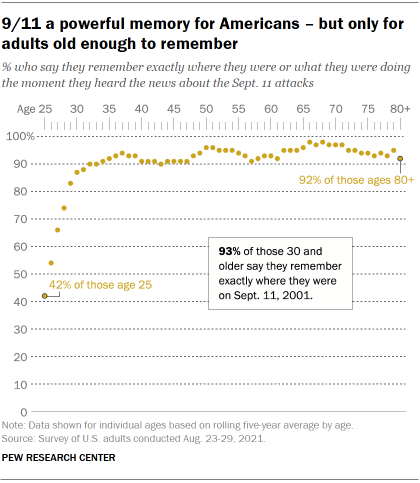
The enduring ability of the Sept. 11 attacks is clear: An overwhelming share of Americans who are old enough to recall the day remember where they were and what they were doing when they heard the news. Yet an ever-growing number of Americans have no personal retentivity of that day, either because they were too immature or not yet built-in.
A review of U.S. public stance in the 2 decades since 9/11 reveals how a badly shaken nation came together, briefly, in a spirit of sadness and patriotism; how the public initially rallied behind the wars in Afghanistan and Iraq, though support waned over time; and how Americans viewed the threat of terrorism at home and the steps the government took to combat it.
Every bit the land comes to grips with the tumultuous exit of U.S. military forces from Afghanistan, the departure has raised long-term questions about U.Southward. foreign policy and America's place in the globe. Still the public'southward initial judgments on that mission are clear: A majority endorses the decision to withdraw from Transitional islamic state of afghanistan, even every bit information technology criticizes the Biden administration'southward treatment of the situation. And later a war that price thousands of lives – including more than two,000 American service members – and trillions of dollars in military spending, a new Pew Research Eye survey finds that 69% of U.South. adults say the United states has mostly failed to reach its goals in Afghanistan.
This test of how the United States changed in the two decades following the Sept. 11 terrorist attacks is based on an analysis of past public stance survey data from Pew Research Center, news reports and other sources.
Electric current data is from a Pew Inquiry Centre survey of 10,348 U.South. adults conducted Aug. 23-29, 2021. Most of the interviewing was conducted before the Aug. 26 suicide bombing at Kabul drome, and all of information technology was conducted before the completion of the evacuation. Everyone who took part is a member of the Eye'southward American Trends Panel (ATP), an online survey panel that is recruited through national, random sampling of residential addresses. This way near all U.Southward. adults have a chance of selection. The survey is weighted to be representative of the U.S. adult population past gender, race, ethnicity, partisan affiliation, pedagogy and other categories. Read more about the ATP's methodology.
Here are the questions used for the report, along with responses, and its methodology.
A devastating emotional cost, a lasting historical legacy
Daze, sadness, fright, anger: The 9/11 attacks inflicted a devastating emotional price on Americans. Merely equally horrible as the events of that solar day were, a 63% majority of Americans said they couldn't stop watching news coverage of the attacks.
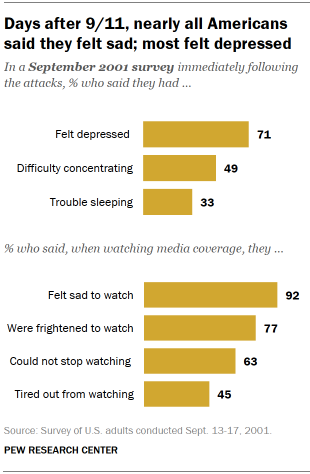
Our offset survey following the attacks went into the field only days after 9/xi, from Sept. xiii-17, 2001. A sizable bulk of adults (71%) said they felt depressed, almost half (49%) had difficulty concentrating and a third said they had trouble sleeping.
It was an era in which television was still the public's dominant news source – 90% said they got most of their news most the attacks from television, compared with just 5% who got news online – and the televised images of death and destruction had a powerful impact. Around nine-in-ten Americans (92%) agreed with the argument, "I feel sad when watching Television set coverage of the terrorist attacks." A sizable bulk (77%) also constitute it frightening to watch – but almost did so anyway.
Americans were enraged by the attacks, besides. 3 weeks later 9/11, even as the psychological stress began to ease somewhat, 87% said they felt angry virtually the attacks on the World Trade Eye and Pentagon.
Fright was widespread, non only in the days immediately later on the attacks, just throughout the fall of 2001. Most Americans said they were very (28%) or somewhat (45%) worried about another attack. When asked a yr later to describe how their lives changed in a major mode, about half of adults said they felt more afraid, more careful, more than distrustful or more than vulnerable as a result of the attacks.
Even after the firsthand shock of 9/xi had subsided, concerns over terrorism remained at higher levels in major cities – especially New York and Washington – than in small-scale towns and rural areas. The personal impact of the attacks likewise was felt more keenly in the cities straight targeted: Nearly a year after nine/xi, near half dozen-in-10 adults in the New York (61%) and Washington (63%) areas said the attacks had inverse their lives at least a little, compared with 49% nationwide. This sentiment was shared past residents of other large cities. A quarter of people who lived in large cities nationwide said their lives had changed in a major way – twice the rate constitute in small towns and rural areas.
The impacts of the Sept. eleven attacks were deeply felt and slow to misemploy. Past the following August, half of U.Due south. adults said the country "had changed in a major fashion" – a number that actually increased, to 61%, 10 years later the consequence.
A year after the attacks, in an open-ended question, almost Americans – 80% – cited 9/eleven as the nearly important event that had occurred in the state during the previous yr. Strikingly, a larger share besides volunteered it as the most important matter that happened to them personally in the prior twelvemonth (38%) than mentioned other typical life events, such as births or deaths. Again, the personal touch was much greater in New York and Washington, where 51% and 44%, respectively, pointed to the attacks as the most significant personal issue over the prior yr.
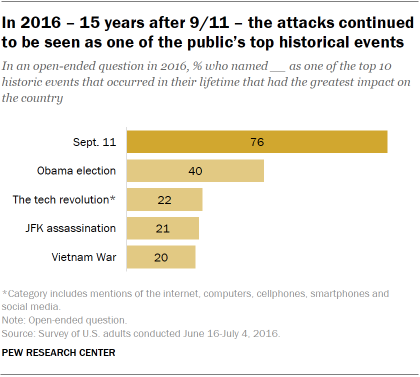
Just every bit memories of nine/11 are firmly embedded in the minds of nearly Americans former enough to remember the attacks, their historical importance far surpasses other events in people's lifetimes. In a survey conducted by Pew Enquiry Middle in association with A+Eastward Networks' HISTORY in 2022 – xv years after 9/xi – 76% of adults named the Sept. xi attacks as 1 of the 10 historical events of their lifetime that had the greatest bear on on the country. The election of Barack Obama as the first Black president was a distant 2nd, at 40%.
The importance of 9/xi transcended age, gender, geographic and even political differences. The 2022 study noted that while partisans agreed on picayune else that election cycle, more than vii-in-ten Republicans and Democrats named the attacks as one of their meridian 10 historic events.
9/11 transformed U.S. public opinion, just many of its impacts were brusk-lived
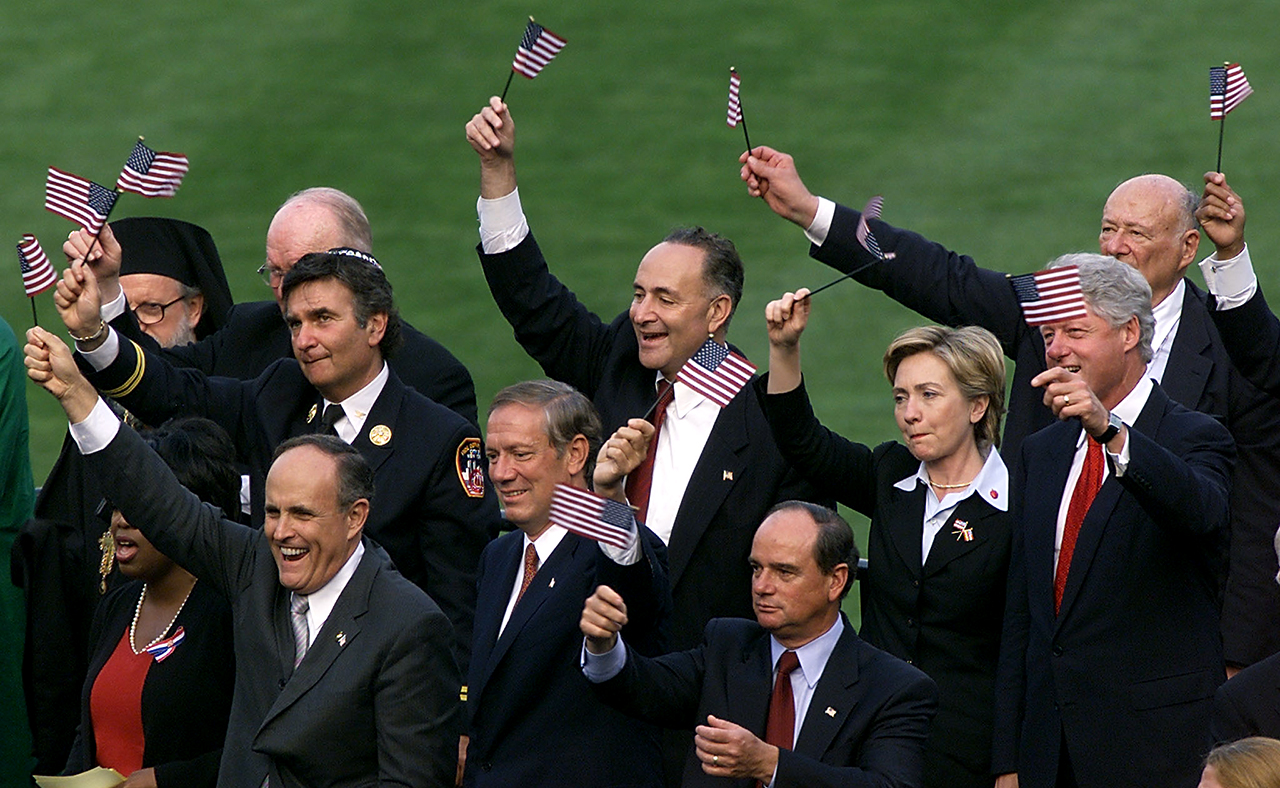
It is difficult to think of an event that so profoundly transformed U.South. public stance across then many dimensions every bit the 9/11 attacks. While Americans had a shared sense of anguish later on Sept. 11, the months that followed too were marked by rare spirit of public unity.

Patriotic sentiment surged in the aftermath of 9/11. Afterwards the U.S. and its allies launched airstrikes against Taliban and al-Qaida forces in early October 2001, 79% of adults said they had displayed an American flag. A year after, a 62% majority said they had often felt patriotic every bit a result of the 9/11 attacks.
Moreover, the public largely set up aside political differences and rallied in support of the nation's major institutions, likewise as its political leadership. In Oct 2001, threescore% of adults expressed trust in the federal authorities – a level not reached in the previous three decades, nor approached in the ii decades since so.
George W. Bush, who had become president nine months before after a fiercely contested ballot, saw his job approval rise 35 percent points in the space of three weeks. In late September 2001, 86% of adults – including nearly all Republicans (96%) and a sizable bulk of Democrats (78%) – approved of the way Bush-league was handling his job every bit president.
Americans also turned to organized religion and faith in large numbers. In the days and weeks later ix/eleven, most Americans said they were praying more than often. In November 2001, 78% said religion's influence in American life was increasing, more than double the share who said that eight months earlier and – like public trust in the federal regime – the highest level in iv decades.
Public esteem rose even for some institutions that usually are not that popular with Americans. For example, in November 2001, news organizations received record-loftier ratings for professionalism. Around seven-in-x adults (69%) said they "stand up for America," while threescore% said they protected commonwealth.
Notwithstanding in many means, the "9/11 effect" on public opinion was short-lived. Public trust in government, besides equally confidence in other institutions, declined throughout the 2000s. By 2005, following another major national tragedy – the government'due south mishandling of the relief effort for victims of Hurricane Katrina – just 31% said they trusted the federal government, one-half the share who said and so in the months after ix/xi. Trust has remained relatively low for the past two decades: In April of this year, only 24% said they trusted the regime just about ever or virtually of the time.
Bush'due south approval ratings, meanwhile, never again reached the lofty heights they did shortly after 9/xi. By the finish of his presidency, in December 2008, just 24% approved of his job functioning.
U.S. armed services response: Afghanistan and Iraq
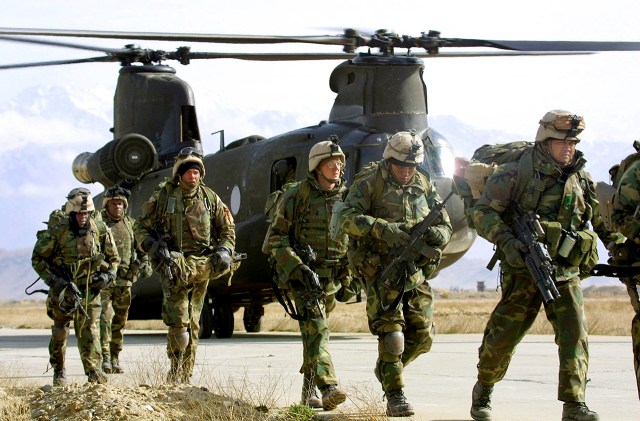
With the U.S. now formally out of Afghanistan – and with the Taliban firmly in control of the country – virtually Americans (69%) say the U.S. failed in achieving its goals in Transitional islamic state of afghanistan.
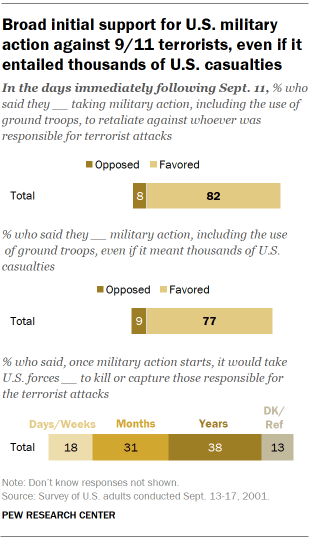
But xx years ago, in the days and weeks following 9/xi, Americans overwhelmingly supported military activity against those responsible for the attacks. In mid-September 2001, 77% favored U.S. military action, including the deployment of regular army, "to retaliate confronting whoever is responsible for the terrorist attacks, even if that means U.Southward. military might suffer thousands of casualties."
Many Americans were impatient for the Bush administration to give the go-alee for military machine action. In a late September 2001 survey, nearly one-half the public (49%) said their larger business concern was that the Bush administration would not strike apace enough confronting the terrorists; just 34% said they worried the assistants would motion too quickly.
Fifty-fifty in the early stages of the U.S. military response, few adults expected a military machine operation to produce quick results: 69% said information technology would take months or years to dismantle terrorist networks, including 38% who said it would take years and 31% who said information technology would accept several months. Just 18% said it would take days or weeks.
The public's support for military intervention was evident in other ways likewise. Throughout the autumn of 2001, more than Americans said the best fashion to prevent future terrorism was to take military machine activity away rather than build upward defenses at home. In early October 2001, 45% prioritized armed forces action to destroy terrorist networks around the world, while 36% said the priority should be to build terrorism defenses at home.
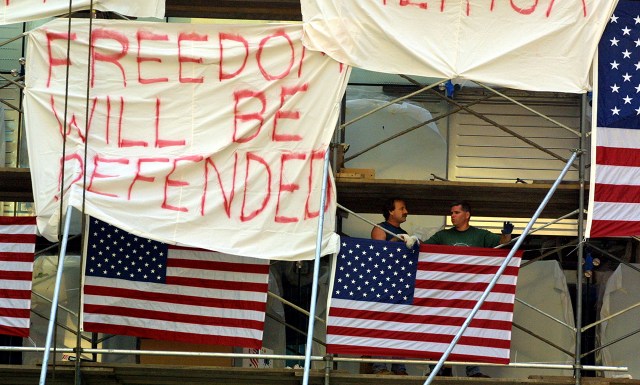
Initially, the public was confident that the U.Southward. military effort to destroy terrorist networks would succeed. A sizable majority (76%) was confident in the success of this mission, with 39% saying they were very confident.
Support for the war in Afghanistan continued at a high level for several years to come up. In a survey conducted in early 2002, a few months after the start of the state of war, 83% of Americans said they canonical of the U.S.-led war machine campaign against the Taliban and al-Qaida in Afghanistan. In 2006, several years after the United States began combat operations in Afghanistan, 69% of adults said the U.S. made the right conclusion in using armed forces force in Transitional islamic state of afghanistan. Just two-in-x said information technology was the wrong decision.
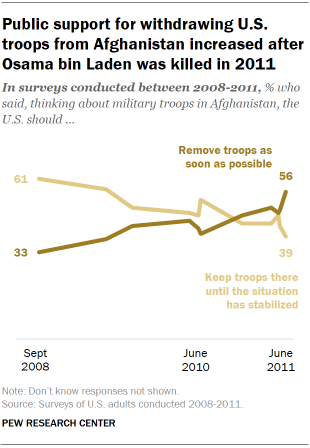
But as the conflict dragged on, first through Bush-league's presidency and then through Obama'southward administration, support wavered and a growing share of Americans favored the withdrawal of U.Southward. forces from Afghanistan. In June 2009, during Obama's starting time year in role, 38% of Americans said U.S. troops should be removed from Afghanistan as before long every bit possible. The share favoring a speedy troop withdrawal increased over the adjacent few years. A turning point came in May 2011, when U.Southward. Navy SEALs launched a risky operation against Osama bin Laden's chemical compound in Pakistan and killed the al-Qaida leader.
The public reacted to bin Laden's death with more than of a sense of relief than jubilation. A calendar month later, for the beginning time, a majority of Americans (56%) said that U.Due south. forces should be brought domicile as presently every bit possible, while 39% favored U.S. forces in the country until the state of affairs had stabilized.
Over the side by side decade, U.S. forces in Afghanistan were gradually fatigued downwards, in fits and starts, over the administrations of 3 presidents – Obama, Donald Trump and Joe Biden. Meanwhile, public support for the decision to utilise forcefulness in Afghanistan, which had been widespread at the start of the disharmonize, declined. Today, after the tumultuous exit of U.South. troops from Transitional islamic state of afghanistan, a slim majority of adults (54%) say the decision to withdraw troops from the country was the correct determination; 42% say it was the wrong determination.
There was a similar trajectory in public attitudes toward a much more expansive conflict that was part of what Bush termed the "war on terror": the U.S. state of war in Republic of iraq. Throughout the contentious, yearlong contend earlier the U.South. invasion of Iraq, Americans widely supported the apply of military machine forcefulness to end Saddam Hussein's rule in Republic of iraq.
Importantly, well-nigh Americans idea – erroneously, as it turned out – there was a direct connexion betwixt Saddam Hussein and the 9/xi attacks. In October 2002, 66% said that Saddam helped the terrorists involved in the 9/eleven attacks on the World Merchandise Middle and the Pentagon.
In April 2003, during the first month of the Iraq State of war, 71% said the U.Due south. made the correct determination to go to state of war in Iraq. On the 15th anniversary of the war in 2018, just 43% said it was the right conclusion. As with the case with U.S. involvement in Transitional islamic state of afghanistan, more Americans said that the U.S. had failed (53%) than succeeded (39%) in achieving its goals in Iraq.
The 'new normal': The threat of terrorism after 9/eleven
There have been no terrorist attacks on the scale of 9/xi in two decades, but from the public'southward perspective, the threat has never fully gone away. Defending the country from futurity terrorist attacks has been at or nigh the top of Pew Inquiry Center's almanac survey on policy priorities since 2002.
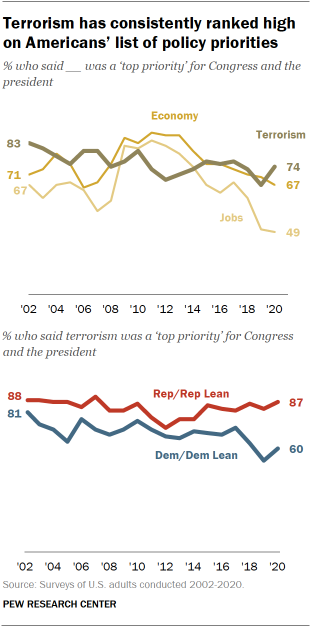
In January 2002, simply months after the 2001 attacks, 83% of Americans said "defending the state from future terrorist attacks" was a top priority for the president and Congress, the highest for any event. Since and so, sizable majorities accept continued to cite that every bit a top policy priority.
Majorities of both Republicans and Democrats have consistently ranked terrorism as a top priority over the past ii decades, with some exceptions. Republicans and Republican-leaning independents accept remained more likely than Democrats and Autonomous leaners to say defending the country from hereafter attacks should be a acme priority. In recent years, the partisan gap has grown larger equally Democrats began to rank the issue lower relative to other domestic concerns.
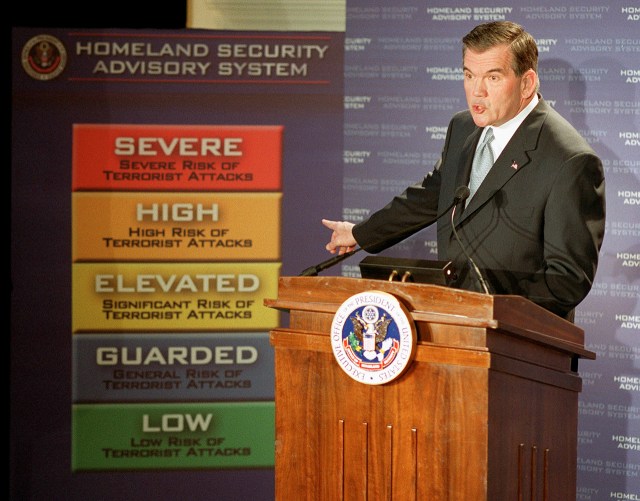
The public's concerns about another assault as well remained adequately steady in the years after nine/11, through nearly-misses and the federal government'south numerous "Orange Alerts" – the second-most serious threat level on its color-coded terrorism warning system.
A 2010 analysis of the public's terrorism concerns constitute that the share of Americans who said they were very concerned almost another attack had ranged from virtually fifteen% to roughly 25% since 2002. The just fourth dimension when concerns were elevated was in February 2003, shortly before the get-go of the U.Due south. war in Iraq.
In recent years, the share of Americans who point to terrorism equally a major national problem has declined sharply equally issues such as the economic system, the COVID-19 pandemic and racism have emerged every bit more pressing problems in the public's eyes.
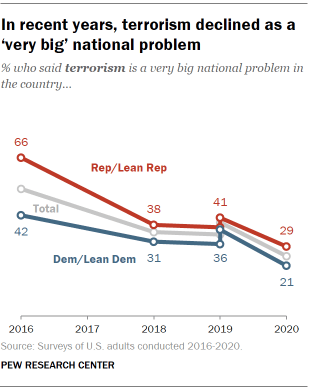
In 2016, most half of the public (53%) said terrorism was a very big national problem in the country. This declined to about iv-in-ten from 2022 to 2019. Last year, merely a quarter of Americans said that terrorism was a very big problem.
This year, prior to the U.S. withdrawal of forces from Afghanistan and the subsequent Taliban takeover of the country, a somewhat larger share of adults said domestic terrorism was a very big national trouble (35%) than said the same about international terrorism. But much larger shares cited concerns such every bit the affordability of health care (56%) and the federal budget deficit (49%) as major problems than said that about either domestic or international terrorism.
Still, contempo events in Afghanistan raise the possibility that opinion could exist changing, at least in the short term. In a late Baronial survey, 89% of Americans said the Taliban takeover of Afghanistan was a threat to the security of the U.Due south., including 46% who said it was a major threat.
Addressing the threat of terrorism at dwelling and abroad
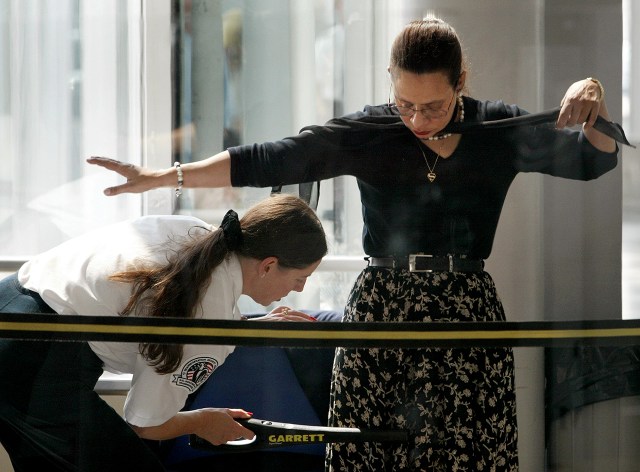
Just as Americans largely endorsed the use of U.S. military strength as a response to the 9/11 attacks, they were initially open to a variety of other far-reaching measures to gainsay terrorism at domicile and abroad. In the days following the set on, for example, majorities favored a requirement that all citizens conduct national ID cards, allowing the CIA to contract with criminals in pursuing suspected terrorists and permitting the CIA to conduct assassinations overseas when pursuing suspected terrorists.
However, well-nigh people drew the line confronting allowing the government to monitor their own emails and phone calls (77% opposed this). And while 29% supported the establishment of internment camps for legal immigrants from unfriendly countries during times of tension or crunch – along the lines of those in which thousands of Japanese American citizens were bars during Globe War II – 57% opposed such a measure.
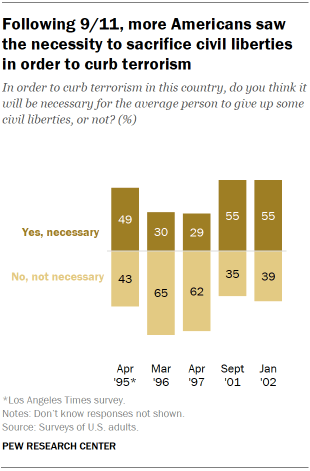
It was articulate that from the public's perspective, the balance between protecting civil liberties and protecting the country from terrorism had shifted. In September 2001 and January 2002, 55% majorities said that, in social club to adjourn terrorism in the U.S., it was necessary for the average citizen to give up some civil liberties. In 1997, simply 29% said this would be necessary while 62% said it would not.
For well-nigh of the next ii decades, more than Americans said their bigger concern was that the government had not gone far enough in protecting the country from terrorism than said it went too far in restricting ceremonious liberties.
The public also did not rule out the utilize of torture to extract information from terrorist suspects. In a 2022 survey of 40 nations, the U.S. was one of only 12 where a majority of the public said the utilize of torture confronting terrorists could be justified to gain data about a possible assail.
Views of Muslims, Islam grew more than partisan in years after 9/11
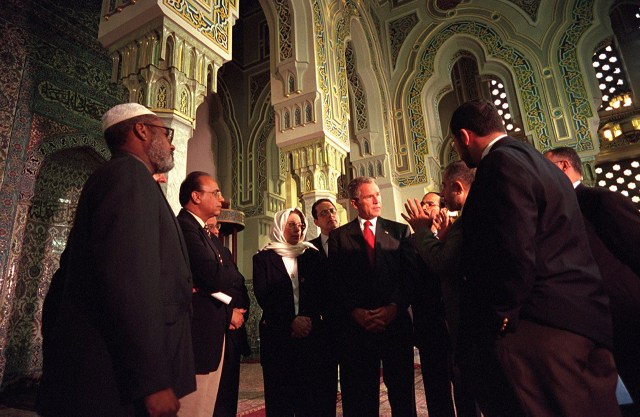
Concerned about a possible backlash confronting Muslims in the U.South. in the days later on ix/eleven, then-President George W. Bush gave a speech communication to the Islamic Center in Washington, D.C., in which he declared: "Islam is peace." For a brief period, a big segment of Americans agreed. In November 2001, 59% of U.S. adults had a favorable view of Muslim Americans, up from 45% in March 2001, with comparable majorities of Democrats and Republicans expressing a favorable stance.
This spirit of unity and comity was not to last. In a September 2001 survey, 28% of adults said they had grown more suspicious of people of Middle Eastern descent; that grew to 36% less than a yr later on.
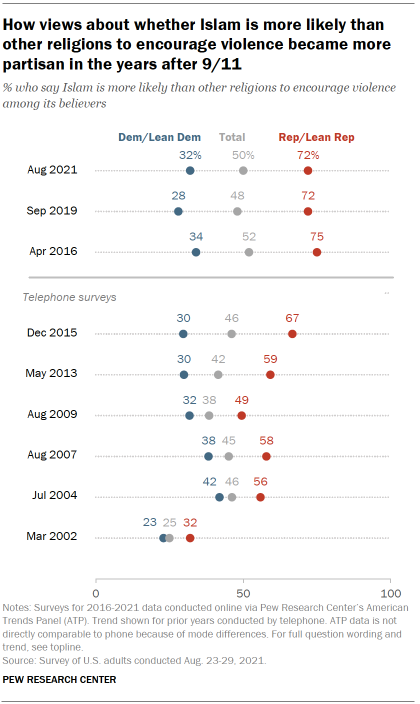
Republicans, in particular, increasingly came to associate Muslims and Islam with violence. In 2002, just a quarter of Americans – including 32% of Republicans and 23% of Democrats – said Islam was more probable than other religions to encourage violence among its believers. About twice equally many (51%) said information technology was not.
Merely within the next few years, about Republicans and GOP leaners said Islam was more than likely than other religions to encourage violence. Today, 72% of Republicans express this view, according to an August 2022 survey.
Democrats consistently have been far less likely than Republicans to associate Islam with violence. In the Center's latest survey, 32% of Democrats say this. Notwithstanding, Democrats are somewhat more likely to say this today than they accept been in recent years: In 2019, 28% of Democrats said Islam was more probable than other religions to encourage violence among its believers than other religions.
The partisan gap in views of Muslims and Islam in the U.S. is evident in other meaningful ways. For example, a 2022 survey constitute that half of U.S. adults said that "Islam is not office of mainstream American society" – a view held by near seven-in-x Republicans (68%) but just 37% of Democrats. In a separate survey conducted in 2017, 56% of Republicans said in that location was a bully deal or fair amount of extremism amid U.S. Muslims, with fewer than half as many Democrats (22%) saying the same.
The rise of anti-Muslim sentiment in the aftermath of ix/11 has had a profound issue on the growing number of Muslims living in the United States. Surveys of U.S. Muslims from 2007-2017 establish increasing shares saying they have personally experienced bigotry and received public expression of support.
Information technology has at present been two decades since the terrorist attacks on the Earth Trade Centre and Pentagon and the crash of Flying 93 – where only the backbone of passengers and coiffure possibly prevented an even deadlier terror attack.
For most who are former plenty to remember, it is a day that is impossible to forget. In many ways, ix/11 reshaped how Americans remember of war and peace, their own personal safety and their fellow citizens. And today, the violence and chaos in a country half a world abroad brings with information technology the opening of an uncertain new chapter in the post-nine/eleven era.
Source: https://www.pewresearch.org/politics/2021/09/02/two-decades-later-the-enduring-legacy-of-9-11/
0 Response to "The United States Map Ok Google Tell Me if the Twin Towers or Build Again From the 911"
Enregistrer un commentaire