Nazi Camp Art Roll Call Is Too Long My Feet Are Screaming
'One Long Dark' Tells Harrowing History Of Concentration Camps eleven:06 Copy the lawmaking below to embed the WBUR audio player on your site
Copy the lawmaking below to embed the WBUR audio player on your site
Play
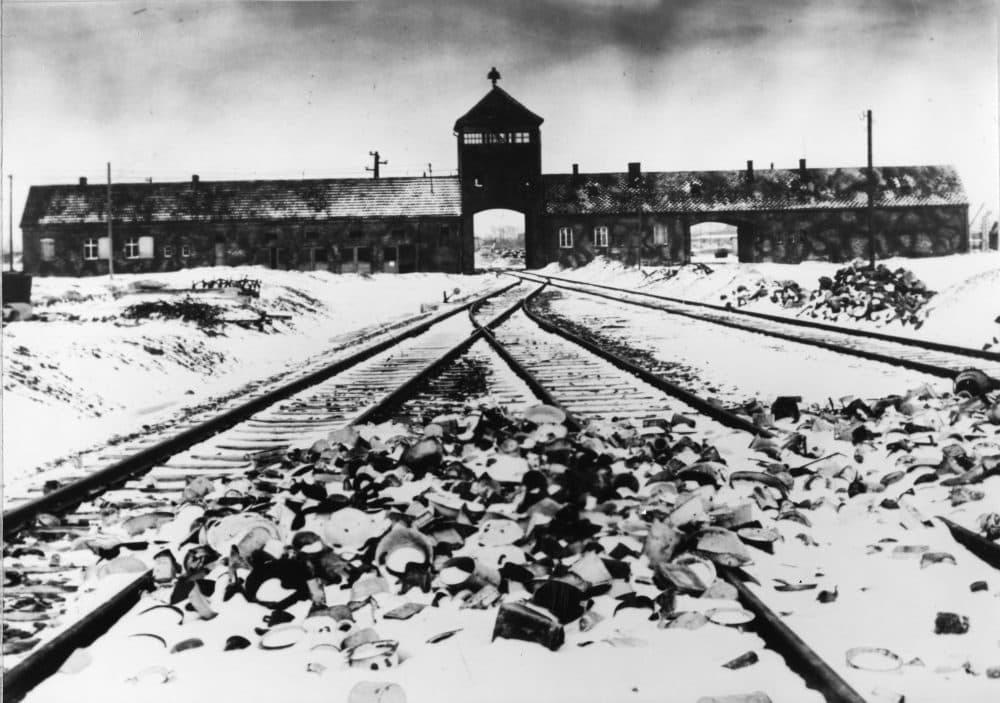
For more than 100 years, at least one concentration campsite has existed somewhere on globe. A new volume documents the harrowing history of concentration camps and what author Andrea Pitzer calls the "larger concentration camp tapestry" — beginning with 1890s Cuba and continuing, she says, with Guantanamo Bay today.
"When people think of camps they just think of the death camps," Pitzer says. "They think of Auschwitz, but actually there'due south this centurylong history of all different kinds of camps: transit camps, displacement camps, internment camps, labor camps."
Here & Now's Lisa Mullins speaks with Pitzer (@andreapitzer), writer of "One Long Nighttime: A Global History of Concentration Camps."
- Find more than great reads on theHither & Now bookshelf
- Scroll down to read an excerpt from "One Long Night"
Interview Highlights
On the start case of these camps that Pitzer documents, later the sinking of the USS Maine
"In 1898, everybody remembers the [USS] Maine. 'Remember the Maine! To hell with Kingdom of spain!' as the reason that the U.Southward. entered the Castilian-American War. But the reason the U.S. was primed to go to state of war was considering for more than a year they had been seeing all kinds of coverage, including photos of people starving and dying, in these concentration camps. And we had been sending relief supplies, food and beans and condensed milk, to try to aid these people in these camps. And we really saw what Espana was doing every bit an outrage. And President McKinley, when he chosen for state of war with Kingdom of spain, talked near this, and he said, 'This policy of these concentration camps was not state of war by any civilized means. It was extermination and leads, basically, to nothing just the wilderness and the grave.' It was a very dramatic thing."
On the U.s.a.' implementation of these camps in the Philippines
"It's one of those things where, when faced with the same circumstances — when the U.S. inherited the Philippines from Kingdom of spain subsequently the state of war and was faced itself with an insurgency — information technology was very hard to ignore this new tool that they had seen lying around not that long ago. And it was an interesting statement, though, considering the people against them said the president just said they were terrible in Spain, and so other people had to argue, 'Well he wasn't saying that in an official capacity.' Then you get into this double speak about camps very, very early on."
On how concentration camps during World War 2 began
"There was that get-go decade or so of these colonial camps, and so they kind of fell into disrepute. Then in Globe War I, in that location was massive employ of it, and you went from virtually no camps in the world — by the cease of Earth War I they were on six continents. So when the Nazi camps started, they looked very much, to outside eyes, similar things that had been done in Soviet Russia or in internment camps during Earth War I. And a lot of people don't realize that it's really five or half-dozen years before the Nazis begin to target Jews equally a grouping, to arrest and detain in camps. And even after that, they permit almost all of them go at one point. They wanted the Jews to leave the state. But it'due south when the world didn't do much about it that I think is a large part of the reason that the Nazis realized they might use the camps at the heart of some other kind of strategy. In that location was yet a decided and public lack of willingness to host refugees. The Nazis had terrorized the Jews for this period during Kristallnacht in November 1938 and the globe really didn't practise much well-nigh it. And they realized that they could do some pretty awful things and get away with it."

On internment camps for Japanese-Americans, and their place in the research
"I include that as part of the larger concentration campsite tapestry. When people think of camps they just think of the death camps. They retrieve of Auschwitz, simply actually there'southward this centurylong history of all different kinds of camps: transit camps, deportation camps, internment camps, labor camps. But I would definitely put the Japanese-American internment in that category, especially since the majority of those interned were U.S. citizens later World State of war II."
On persecution of the Rohingya
"I actually went to Myanmar in 2015. People had been there at that point for iii years, and they were quite hopeful ahead of the elections that were going to happen that fall. And, in fact, Aung San Suu Kyi did come in, simply in that time subsequently the elections, the people that I kept in touch with after I returned to the U.Due south. actually seemed to lose hope. I think that they thought, not that she would deliquesce the camps overnight, but that some kind of progress would be made. And when no progress was made I think a real full general despair gear up in and we ended up on this path that we're on today in which the government has really been brutalizing the Rohingya.
"One of the interpreters that I was dealing with there that took me around the camps, so a Rohingya man in the camps, nosotros were talking about it and I said, 'Couldn't you lot go out at nighttime? Couldn't yous brand your way out of here? Why does anybody stay?' And he said that he couldn't — that even if he got out, it wouldn't matter considering everybody would know he was a Rohingya. This was his hometown. He would be recognized. And I said, 'What would happen if you were defenseless? Would you go a trial case? What would happen?' And he said, 'If I'1000 caught, I don't even exist.' And that was his sense of where the people were. They were stateless, they had been stripped of everything. No one would be accountable if something happened to him."

On instances of people escaping various camps
"One of my favorite examples is in the first months of Dachau there was a communist deputy from the Reichstag who managed to escape after days and days of horrific torture, managed to sneak out with a little assistance through a tiny window at the superlative of his cell. And he got out of the state, and he sent a postcard to the guards at the camp with an expletive in it telling them exactly what they could do with themselves. Only in improver, the prisoners found means to bandy bodies, they institute means to put on circuses and entertain each other. Sometimes the guards would watch, sometimes they would do this secretly. They would share recipes with each other — the amazing things people did to sustain themselves. It's pretty incredible."
On the process of documenting this history
"I felt really honored past the stories that people shared with me of the things that they had gone through and overcome, but information technology was too very difficult. I establish myself writing slower, and slower, and slower, and the book took me about a year more than I expected information technology to, initially. I think it was merely the the weight of this history and also that it'southward still going on. Guantanamo is a slice of this history, and I'chiliad all the same in affect with those Rohingya people that I met in the camp. Some of them I'yard withal able to contact. I talk with them every calendar week. So it's not a dead, closed history. It's an ongoing thing, and the burden of hoping that the book will do something most that — I still feel that today."
On how the Rohingya she speaks with are doing
"The ones that I'thousand in bear upon with are sort of property fast. They are below the area that the military has sort of been called-for villages in and forcing people across the edge. So, for correct at present, that hasn't affected them much. They are nevertheless in the military camp setting. But of course information technology makes it clear what the federal government is willing to practise and what could happen at any time. And so it's very precarious and nervus-wracking, but so far they haven't come to physical damage."
On conclusions nigh humanity and the camps
"What I've found that I call up is a really important takeaway is — and it does provide a piffling promise — people take to exist coached to do this. This is not something that arises sort of independently out of nowhere. There are always gonna be some narrow band of people who want to harm other groups, that always exists. But yous really have to put the strength of a authorities or a party or a huge institution behind it, and do sustained propaganda, to become people to continue with it — to make people mean, just even more so, fearful enough, to allow this kind of stuff to happen. Then I think the key is strengthening these institutions that don't permit this to happen. It'south really, actually critical for us. So it is something that, having been introduced into the world, is unlikely to get out information technology. But at the same time, information technology isn't something that's just going to automatically arise on its own."

Book Excerpt: 'One Long Night'
By Andrea Pitzer

By the fourth dimension she was loaded into a cattle motorcar leap for Auschwitz, Krystyna Żywulska had endured multiple traumas in the destruction of her native Poland. Born Sonia Landau to a Jewish family in the metropolis of Łódź, she had been forced out of law school past the Nazi invasion in 1939. Afterwards escaping the Warsaw Ghetto with her female parent, she joined the Shine resistance, only to exist captured. Detained with her friend Zosia, she wound upward at Pawiak Prison house in Warsaw. Under interrogation there, she took upward a new identity: that of a Christian Pole named Krystyna Żywulska.
By 1943, Żywulska and the other prisoners in the women's section at Pawiak had years of rumors and feel to draw on. So when they were told to line up and herded into the transport cell knowing they were headed to Auschwitz, they believed they were going to their deaths. Pawiak had flea infestations, brutal daily interrogations, suicide attempts, and fifty-fifty killings, only it lacked the finality of Auschwitz. As they prepared to leave, a cellmate broke the gloom, saying, "At least yous'll get a beautiful haircut."
They sped in trucks through the metropolis to the train station, watching residents headed to work. Driven onto crowded cars, the prisoners waited for the train to move, and finally arrived in an open up field later dark. The snarling dogs, the columns of five, the frightening march toward the spinous wire and watch boxes on high towers visible from a distance—now she had seen a death campsite. Standing next to her, Zosia, her former landlord and sister in the underground, spoke: "We've entered hell."
Żywulska was tattooed with prisoner number 55908. Her head was shaved, and she was deloused. Each detainee suddenly seemed indistinct and unrecognizable. Subsequently two days with no food or water, they were given turnip soup and four ounces of bread, a full day'south ration. They ate everything without thought, equally speedily every bit they could, which spurred the realization that they had already turned into animals.
They squatted in a big field for the day, waiting to be let into the quarantine hut to sleep. A woman who had been arrested during her wedding withal wore her gown and held a bouquet equally she comforted i of the guests brought to Auschwitz with her.
During her calendar month of quarantine, Żywulska learned how to sleep in the crowded bunks and navigate the guards. She found that bread could buy a constellation of things, because there was never enough of information technology. Hunger at Auschwitz was a constant state. Out of earshot of camp administrators, prisoners were perpetually in conversation aimed at distracting themselves from the longing for nutrient.
Contraband entered the camp through the prisoners who candy the belongings of Jewish transports. Family members could send parcels of canonical items to prisoners, besides, though Jewish prisoners were non permitted to receive packages. Żywulska imagined a magical twenty-four hour period when she, as well, might get a package from home. In the meantime, Zosia plotted how she could steal a sweater to continue her friend warm.
1 morn, detainees heard a shrill whistle and were told to get to their block and stay inside. Soon later, a midmorning roll phone call was announced—but only for Jewish prisoners. Żywulska watched as women from the adjacent edifice were forced to line up, each one trying to avoid the front row. A familiar, hated SS executioner, unsteady on his feet and obviously boozer, proceeded to point with his cane at private women. After they undressed, he directed each one to his right or his left. In time, it became clear that the small percentage of good for you prisoners went to the left. A chiliad women in the vivid sunlight stood in total silence. The prisoners in rows, the detainees nonetheless in their blocks spying through windows, the hundreds of women who had just been sent to the right—anybody understood that they had merely witnessed a selection.
In the weeks that followed, Żywulska received a first parcel from her mother, which she could hardly open for weeping. Because she found coil phone call unbearable, she began to compose poems in her head, a matter she had never done earlier. Notwithstanding setbacks occurred continuously. She watched as a new associate who had survived interrogations and torture at Auschwitz was taken away for good by the Gestapo. She and Zosia had to abscond their barracks and hide to avert beingness chosen for service in the military camp brothel. Another prisoner's ill-tied diarrhea resulted in collective punishment of kneeling in the mud—which led to widespread fever. For the outset time, she was separated from Zosia, who fell sick.
After nearly succumbing to work in the fields, Żywulska was assigned to the camp office. Her conservancy came through assist from a still-man kapo—one who had admired a poem she had written about forenoon roll phone call.
Assigned to process new arrivals, Żywulska learned to corral and reassure them. She could not bring herself to hit prisoners with a stick. Children came in with their mothers and lined up with them at curl telephone call, merely to be taken abroad for denationalization and integration into High german social club. A Ukrainian adult female gave up hope and made a run at the spinous wire perimeter fence, knowing she would be shot.
One nighttime during a concert performed by prisoners for administrators, kapos, and guards, Żywulska stopped in to watch a Jewish violinist from Vienna play and carry. Just before the concert, she had seen the detainees of Block fifteen kneeling for punishment. She had watched the elegant, dark-haired Greek Jews sifting through the kitchen garbage for basic to chew on. As the orchestra played, Żywulska used the lark of the operation to slip into the typhus-ridden infirmary ward and bring warm water to Zosia. Zosia, who had endured alongside her since the trip from Pawiak Prison, who had wondered if they would roast together in hell, before long died anyway.
Anything was possible at Auschwitz, and nothing made sense. Żywulska came downwardly with typhus, besides, and lay unconscious for several days. The violinist from the performance swallowed poisonous substance and killed herself. A former Soviet parachutist screamed in the dark and was tied to her bed. Żywulska 's scabies began to itch, and she clawed herself, hoping to die. Notwithstanding afterward she was clandestinely sent medicine past a male prisoner who had kissed her during outdoor duties in her first weeks at Auschwitz, Żywulska recovered. An intervention by the same kapo who had admired her writing helped to keep her, once again, from cruel outside labor.
Before long after her recovery, a group of French women were taken in trucks to their deaths singing "La Marseillaise." A patient in the infirmary hid among corpses in order to avert beingness selected for death with the sickest detainees, though she would surely be called in the next circular. Another prisoner wondered at the endeavor anybody was making: "Why do we want then much to live?"
After weeks in the hospital, Żywulska finally joined her new block for roll phone call. Dorsum in the tiny universe of the camp, she watched a prisoner beaten for stealing potatoes. An SS human being on a cycle paused for a moment to attack an old adult female. The crematorium chimney spat burn down into the heaven. The kapos were the same, the endless routines of the camp remained, but new prisoners lined up in place of the dead.
Excerpted from the volume ONE LONG NIGHT by Andrea Pitzer. Copyright © 2017 by Andrea Pitzer. Republished with permission of Piddling, Brown and Company.
Source: https://www.wbur.org/hereandnow/2017/12/29/andrea-pitzer-one-long-night
0 Response to "Nazi Camp Art Roll Call Is Too Long My Feet Are Screaming"
Enregistrer un commentaire